

By : GA Consulting May 8, 2026
Publish date: May 8, 2026
Think about how many people in India earn a living outside the traditional job structure. The delivery rider who drops off your order. The freelancer running projects for five different clients. The contract worker hired for a six-month infrastructure project. The domestic worker who's been with the same family for fifteen years.
For most of them, the existing social security framework — built around the idea of stable, long-term employment with a single registered employer — was never really designed to work.
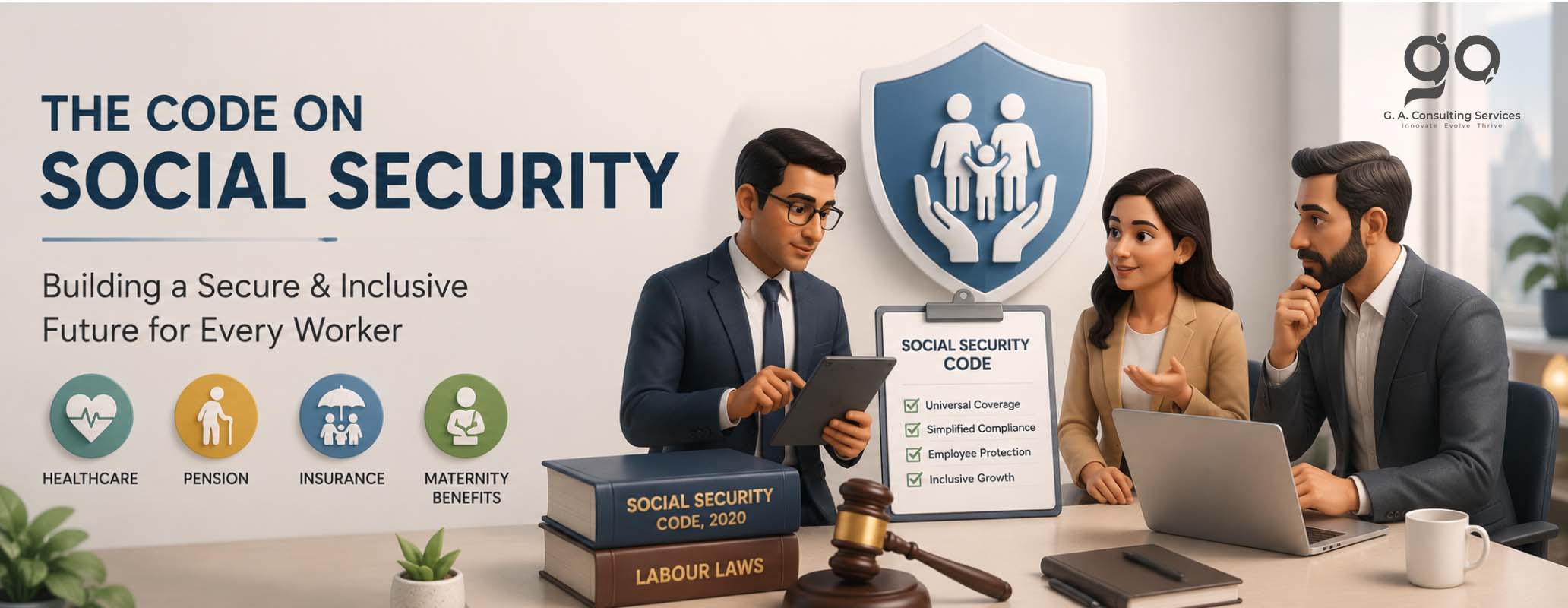
The Code on Social Security, 2020 is the most significant attempt India has made to fix this. It doesn't solve everything, and implementation is still a work in progress. But it represents a genuine structural shift in who the law considers worth protecting — and that shift matters.
India's social security system before 2020 was spread across seven separate laws, each with its own definitions, thresholds, and eligibility criteria. The Employees' Provident Fund Act covered retirement savings. The ESIC Act covered health insurance. The Gratuity Act governed long-service payouts. And so on.
In theory, this gave workers a comprehensive protection system. In practice, there were three big problems.
First, coverage was conditional on employment type. If you weren't in a formal employer-employee relationship — as gig workers, platform workers, and the unorganised sector broadly are not — you fell outside the system entirely. Second, the laws were inconsistent with each other. Definitions of 'wages', 'establishment', and 'employee' varied from Act to Act, creating genuine confusion for employers trying to comply and genuine gaps for workers trying to claim benefits. Third, benefits were tied to employer continuity. Workers who changed jobs frequently — which describes a growing proportion of India's workforce — lost out on portability.
India had seven laws that looked like a social security system but collectively left a majority of the workforce without meaningful coverage.
The Code consolidates the following seven into a single framework:
| Law Replaced | What It Covered |
|---|---|
| Employees' Provident Funds Act, 1952 | PF contributions and retirement savings |
| Employees' State Insurance Act, 1948 | Health insurance and sick pay |
| Gratuity Act, 1972 | Long-service benefit on separation |
| Maternity Benefit Act, 1961 | Paid leave and protections for new mothers |
| Employee Compensation Act, 1923 | Workplace injury and disability cover |
| Employment Exchanges Act, 1959 | Employment registration and data |
| BOCW Welfare Cess Act, 1996 | Welfare fund for construction workers |
This isn't just administrative tidying. A single framework means consistent definitions of 'worker', 'wages', and 'establishment' across all benefit types. It means one compliance structure instead of seven. And it creates the architecture for extending coverage — because you can't bring new workforce categories into a fragmented system as easily as you can into a unified one.
Before the Code, gig workers and platform workers had no formal definition in Indian labour law. They weren't covered. They weren't excluded. They simply weren't there.
The Code changes this by formally defining both categories. A gig worker, under the Code, is someone who performs work or participates in a work arrangement that results in earnings outside of a traditional employer-employee contract. A platform worker is someone whose work is organised through or accessed via an online platform — Swiggy, Ola, Upwork, and equivalents.
This recognition is the foundation on which future protection can be built. The Code enables the creation of a dedicated Social Security Fund for gig and platform workers, with contributions potentially coming from aggregator companies, workers themselves, and the government.
What recognition does and doesn't mean right now
It does mean these workers are inside the legal framework for the first time. It means schemes can be created for them. It means aggregator companies have a defined relationship with the social security system — one that will eventually involve financial obligations.
It doesn't yet mean automatic PF, ESIC, or gratuity coverage. The specific schemes — contribution rates, eligibility criteria, benefit structures — are being defined through separate notifications. That work is ongoing. Gig workers who are expecting their provident fund contributions to begin imminently are ahead of where implementation currently sits.
Recognition creates the legal infrastructure for protection. It doesn't automatically deliver it. Think of it as laying a road rather than opening it to traffic.
| Worker Type | Protected Before? | Protected Under the Code? |
|---|---|---|
| Permanent organised sector employees | Yes | Yes |
| Unorganised sector workers | Partially | Yes — expanded schemes |
| Gig workers (e.g. freelancers) | No | Yes — formally defined |
| Platform workers (delivery, ride-hail) | No | Yes — formally defined |
| Fixed-term contract employees | Limited | Yes — parity with permanent staff |
| Inter-state migrant workers | Partially | Yes — dedicated provisions |
This is a meaningful expansion from the pre-Code framework, which was largely designed around permanent employment in establishments above a minimum headcount. Millions of workers who previously had no formal protection are now inside the definitional boundary of the law — even where specific scheme coverage is still being built out.

If you're in the organised sector
Your core benefits — PF, ESIC, gratuity, maternity — remain intact. The Code doesn't reduce anything for you. What changes is the definitional consistency around those benefits, and the improved portability mechanisms the framework is designed to enable. If you've ever had to chase down a PF transfer after changing jobs, the Code is designed to make that smoother over time.
If you're on a fixed-term contract
This is where the change is most concrete and immediate. Fixed-term employees are now entitled to gratuity on a pro-rated basis, regardless of how long they've served. Under the old system, the five-year minimum for gratuity eligibility meant that most contract workers — by design — never qualified. The Code removes that structural exclusion.
If you're a gig or platform worker
You're now formally part of the legal landscape. Welfare schemes are being designed for your category. Aggregator companies will have contribution obligations. This is genuinely new territory — but it is moving, and workers in this space should follow state-level notifications, because implementation will vary.
If you're in the unorganised sector
The Code consolidates welfare provisions for unorganised workers and inter-state migrants, with expanded eligibility frameworks. Again, the specific schemes and contribution structures vary and are still being operationalised in many states.

Simplified compliance, but broader obligations
A single unified law with consistent definitions is genuinely easier to comply with than seven overlapping Acts. That's a real advantage, especially for businesses that span multiple employment categories. The compliance burden on paper is lower.
But the scope of obligation is expanding. More workers, more workforce types, more situations where contribution requirements will apply. Businesses in the platform economy — logistics companies, aggregators, digital marketplaces — need to be planning for contribution structures even before the final rates are notified, because the direction of travel is clear.
Classification matters more now
The definitions in the Code draw lines — between employees and gig workers, between platform workers and independent contractors. Those lines determine who you're obligated to contribute for and under which scheme. Getting classification wrong, even unintentionally, creates compliance exposure. A workforce audit against the Code's definitions is a sensible precaution for any business with a mixed or non-traditional workforce.
State-level variation is significant
The Code requires both Central and state governments to notify rules. Where you operate matters — implementation timelines, specific thresholds, and scheme structures vary considerably by state. Don't assume what applies in one jurisdiction applies in another.
India's workforce has changed faster than its laws. The gig economy expanded rapidly. Fixed-term contracts became a dominant hiring model in many sectors. Millions of workers moved between jobs, platforms, and states — while the legal framework for protecting them stayed designed for a world that largely no longer exists.
The Code on Social Security is a meaningful correction to that mismatch. It won't fix everything at once, and the gap between what the law says and what workers experience on the ground will close slowly. But the structural changes are real: broader definitions, unified compliance, formal recognition for workers who had none, and a framework that can actually expand as India's workforce continues to evolve.
The most important thing for both workers and employers is to understand what the Code actually does — rather than what they've heard it does — and plan accordingly.
If you need help understanding how the Code on Social Security applies to your business or workforce — whether that's a compliance audit, workforce classification review, or regulatory readiness planning — GA Consulting works with employers across India to navigate exactly this.
— GA Consulting | Labour Law & HR Compliance Advisory