


By : GA Consulting April 23, 2026
Publish date: April 23, 2026
In 2020, India passed a law that touched the most sensitive nerve in employer-employee relations: how easily a company can let workers go.
The Industrial Relations Code, 2020 — the third of India's four consolidated Labour Codes — rewrites the rules governing industrial disputes, layoffs, retrenchment, trade unions, and the terms under which people can be employed. It covers territory that previous legislation had held largely unchanged since independence.
Not everyone is happy about it. That's partly because labour law is where economic policy and human livelihood intersect most directly. And partly because some of what the Code changes is genuinely significant.
This post unpacks what the Industrial Relations Code actually does — the specific provisions, the real numbers, what it means for businesses trying to operate efficiently, and what it means for workers trying to understand where they stand.
The Industrial Relations Code consolidates three pieces of legislation that had, between them, governed Indian workplace relations for over seven decades:
| Law Replaced | What It Governed | Why It Was Problematic |
|---|---|---|
| Industrial Disputes Act, 1947 | Layoffs, retrenchment, closures, strikes, dispute adjudication | Prior government approval required for establishments with 100+ workers; dispute resolution could drag for years |
| Trade Unions Act, 1926 | Registration, recognition, and rights of trade unions | No cap on number of unions per establishment; no single negotiating union — led to fragmented bargaining |
| Industrial Employment (Standing Orders) Act, 1946 | Terms of employment, classification of workers, disciplinary rules | Applied inconsistently; definitions didn't account for fixed-term, gig, or modern contract models |
What each of these laws had in common was that they were designed for a specific, mid-20th century idea of employment: a large factory, a permanent workforce, a single employer, long tenures. By 2020, that picture described a shrinking proportion of India's actual workforce. Project-based hiring, fixed-term contracts, gig arrangements, multi-site operations — none of these fit cleanly into the old framework. The Industrial Relations Code is, among other things, an attempt to update the legal architecture for how work is actually organised today.

| Area | Before the IR Code | After the IR Code |
|---|---|---|
| Retrenchment / layoff threshold | Prior government approval required for establishments with 100+ workers | Threshold raised to 300 workers; state governments can raise it further |
| Standing Orders applicability | Applied to establishments with 100+ workers | Now applies to establishments with 300+ workers |
| Fixed-term employment | Not formally defined in central law; no parity with permanent employees | Formally defined; FTE employees get same wages, hours, and statutory benefits as permanent staff |
| Trade union recognition | No structured recognition process; multiple unions could claim representation | Negotiating Union concept introduced; union with 51%+ membership gets recognition |
| Dispute resolution timeline | No statutory timeline for tribunal decisions; cases could linger indefinitely | Structured timelines introduced at tribunal and conciliation levels |
| Reskilling fund | No mandatory reskilling contribution on retrenchment | Employers must contribute 15 days' last drawn wages to a National Reskilling Fund per retrenched worker |
The numbers are what make this concrete. Before the Code, a company with 101 employees had to seek government approval before laying off even one worker. Under the Code, that threshold moves to 300 — and state governments have the power to raise it further. That single change is what has generated most of the debate around this legislation, and understanding it clearly is more useful than either defending or criticising it without context.
Let's be direct about this, because it's the provision that generates the most heat.
Under the Industrial Disputes Act, 1947, establishments with 100 or more workers needed prior government permission before carrying out layoffs, retrenchment, or closure. In practice, getting that permission was slow, uncertain, and sometimes politically complicated. This created a real operational problem: companies approaching the 100-worker mark sometimes avoided growing beyond it, precisely to stay below the threshold.
The IR Code raises this threshold to 300 workers. Companies with fewer than 300 employees can now retrench workers without prior government approval — though they must still provide notice, pay retrenchment compensation at the rate of 15 days' wages per year of service, and contribute to the National Reskilling Fund.
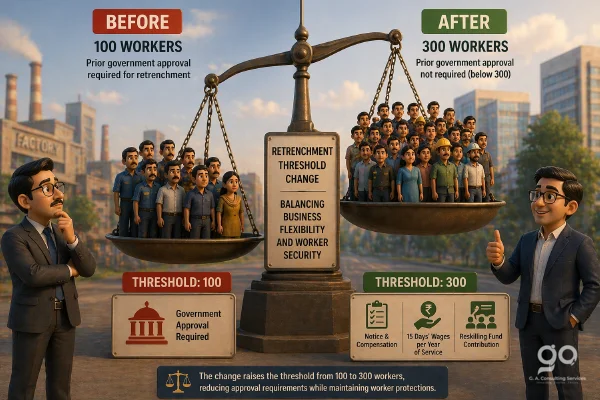
The threshold change doesn't mean employers can retrench freely — it means they no longer need prior approval before doing so for establishments under 300 workers. The obligations on notice, compensation, and reskilling remain.
The concern from labour groups is legitimate: removing the prior approval requirement reduces a procedural safeguard that workers in smaller establishments had relied on. The business argument is equally real: the old threshold created a hiring disincentive that hurt workers by discouraging formal employment growth.
Both things can be true simultaneously, and the honest position is that this is a trade-off — not a clean win for either side.
The formalisation of fixed-term employment is arguably the most practically significant provision in the Code for most workers — and the least discussed.
Before the IR Code, fixed-term employment existed in practice across Indian industry, but without a consistent central legal definition. This created a two-tier workforce: permanent employees with full statutory benefits on one side, and contract or fixed-term workers on the other — often doing the same work, for less pay, with no gratuity and no job continuity.
The Code changes this by formally defining fixed-term employment and mandating parity. Here's what that means in practice:
| What Fixed-Term Employees Now Get | Why This Matters |
|---|---|
| Same wages as permanent employees doing equivalent work | Prevents using FTE as a cost-cutting mechanism through wage suppression |
| Same working hours, leave, and overtime entitlements | No two-tier workforce where contract workers get fewer hours protections |
| Pro-rated gratuity from day one of service | Removes the five-year minimum — FTE workers build gratuity from the first contract |
| All statutory benefits applicable to permanent employees | PF, ESIC, and other contributions apply on the same basis |
| No automatic conversion to permanent employment | Employers retain the ability to structure fixed-duration roles without a conversion obligation |
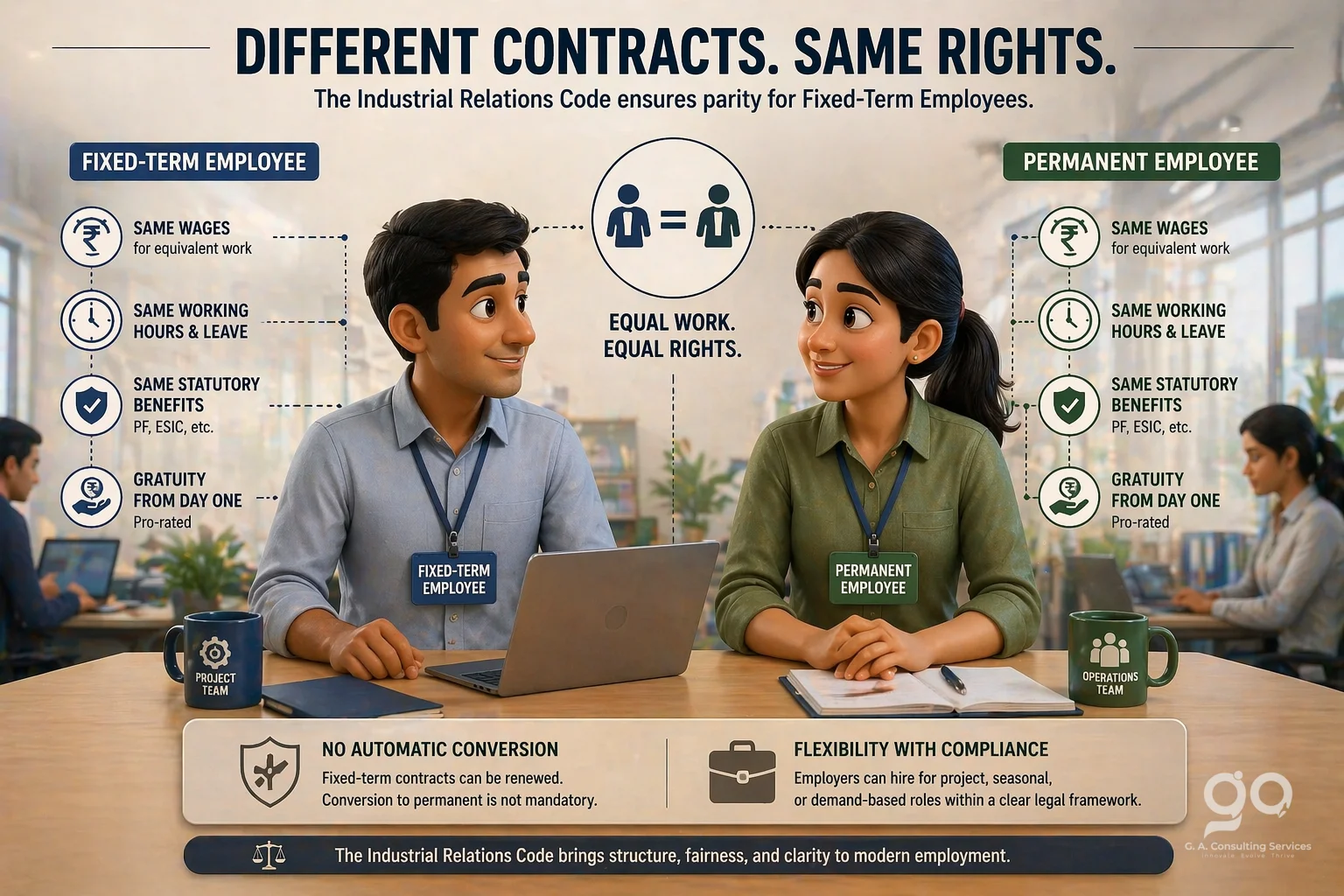
The absence of a conversion obligation is worth noting separately. Some workers had hoped that the formalisation of fixed-term employment would come with an automatic conversion to permanency after a certain period — as happens in some European labour frameworks. It doesn't. Fixed-term contracts can be renewed, and employers are not obligated to convert FTE workers to permanent employees regardless of how many times the contract is renewed.
What workers do gain is benefit parity and gratuity from day one. What employers gain is a compliant, structured way to hire for seasonal, project-based, or demand-driven roles without resorting to informal contractual arrangements that often left everyone — employer and worker — in a legally ambiguous position.
The old Trade Unions Act had a problem that anyone who has managed industrial relations in a large Indian establishment knows well: there was no limit on the number of unions that could be registered in a single workplace, and no mechanism for determining which union actually represented the majority of workers.
This created fragmented bargaining. Multiple unions, each claiming to speak for the workforce, each with different demands and different political affiliations. Negotiating anything meaningful was complicated. Getting a signed agreement that held across factions was harder still.
The IR Code introduces the concept of the Sole Negotiating Union — a union that holds the membership of at least 51% of workers in an establishment gets recognised as the sole negotiating body. If no union holds 51%, a Negotiating Council composed of representatives from all unions is formed instead.
This is a meaningful structural change. It creates clarity around who speaks for workers in collective bargaining. It gives majority unions formal recognition and authority. And it reduces the ability of minority factions to disrupt negotiations or extract concessions through industrial action.
The concern on the worker side is that it potentially marginalises minority unions — particularly those representing specific categories of workers who may not form a majority across the whole establishment. That's a real trade-off, and it's one that the Code doesn't fully resolve.
One provision that rarely makes headlines but deserves attention: when an employer retrenches a worker, the Code requires a contribution of 15 days' last drawn wages to a National Reskilling Fund within 45 days of retrenchment.
This is new. Nothing equivalent existed under the Industrial Disputes Act. The intent is to create a pool of funding that helps retrenched workers access training and transition to new employment. The mechanism — a National Reskilling Fund administered by the government — is still being operationalised.
For employers, it's an additional cost obligation per retrenched worker, on top of the standard retrenchment compensation. For workers, it represents a structural acknowledgment that retrenchment should come with some form of transition support — not just a severance cheque.
The reskilling contribution is 15 days' last drawn wages per retrenched worker, paid within 45 days. It sits alongside — not instead of — standard retrenchment compensation of 15 days per year of service.
| Provision | Impact on Employers | Impact on Employees |
|---|---|---|
| Raised retrenchment threshold (300) | Greater operational flexibility for scaling down without prior approval | Increased job security anxiety in mid-size establishments moving toward 300+ |
| Fixed-term employment framework | Structured, compliant way to hire for project-based and seasonal work | Benefit parity and gratuity entitlement — better than informal contract arrangements |
| Sole Negotiating Union recognition | Single point of negotiation reduces fragmented bargaining | Union with majority membership gains formal bargaining power; minority unions lose leverage |
| Reskilling fund contribution | Additional cost obligation per retrenched worker | Financial support and reskilling access post-retrenchment |
| Structured dispute timelines | Faster resolution of industrial disputes; less prolonged uncertainty | Disputes reach adjudication faster — reducing years-long limbo |
The honest summary: the Code gives employers more operational flexibility on workforce sizing, particularly for establishments approaching 300 workers. It gives fixed-term employees meaningful new protections. It structures union recognition in a way that simplifies — but also reshapes — collective bargaining. And it introduces a reskilling obligation that adds cost to retrenchment while creating a framework for worker transition support.
Industrial disputes under the old framework could drag for years — sometimes decades. Cases wound through conciliation, then tribunals, then courts, with no statutory limit on how long any stage could take. The practical effect was that many workers chose not to pursue legitimate disputes because the process was too slow and too expensive to see through.
The IR Code introduces structured timelines at multiple stages of the dispute resolution process. Conciliation proceedings must be completed within 45 days. Tribunals are required to try to complete proceedings within two years. Industrial Tribunal decisions can be challenged before High Courts, but the framework is designed to reduce the procedural delays that turned minor disputes into prolonged legal battles.
This is unambiguously positive for both sides. Faster dispute resolution reduces uncertainty for employers managing ongoing operations and gives workers a realistic prospect of getting a decision in a reasonable timeframe.
The Industrial Relations Code is genuinely significant — more so than most labour legislation that has passed in India over the past two decades. It changes the threshold at which retrenchment becomes a right rather than an approval-dependent process. It creates a proper legal framework for fixed-term employment with real worker protections. It restructures how unions negotiate. And it introduces a reskilling obligation that, if properly implemented, could meaningfully support workforce transition.
None of these changes are cost-free, and none of them are unambiguously better or worse for every stakeholder. That's why the Code remains debated: it involves real trade-offs between employer flexibility and worker security, and reasonable people can weigh those trade-offs differently depending on where they sit.
What's less debatable is the importance of understanding what the Code actually does. Employers who misread the retrenchment provisions — either overestimating their freedom to retrench without consequence, or underestimating their continuing obligations — create legal exposure. Workers who don't know about fixed-term employment parity miss entitlements they're legally owed.
Clarity on the law is the starting point. How you operate within it is where strategy comes in.
GA Consulting advises businesses on Industrial Relations Code compliance — from workforce restructuring reviews to fixed-term employment framework design and union negotiation preparedness. If your organisation is working through how the IR Code applies to your operations, speak with our team.
— GA Consulting | Labour Law & Industrial Relations Advisory