


By : GA Consulting 21 November, 2025
If you are an employer, HR manager, or payroll professional in India, the new Labour Codes that came into effect on 21 November 2025 directly change how gratuity is calculated and who qualifies for it. Acting now is not optional — non-compliance carries legal and financial risk.
This guide covers exactly what has changed, what it means for your payroll and contracts, and the specific steps your organisation needs to take immediately.
Who this is for: Employers, HR managers, payroll teams, and compliance officers across all industries in India.
What you will know by the end: The exact changes to gratuity rules under the 2025 Labour Codes, how they affect your liabilities and contracts, and the four actions you need to take now.
Related reading: Gratuity is one part of a broader statutory compliance picture. Read our guide on HR Statutory Compliance — covering PF, ESI, gratuity, professional tax, and more — to ensure your organisation meets every labour law requirement.

Use this checklist to audit your current payroll structure, recalculate gratuity liabilities, and update contracts in line with the new Labour Code requirements.
→ Get the checklist
Related reading: Managing gratuity recalculation and payroll restructuring in-house can be complex. Read our guide on Payroll Outsourcing to learn how a managed payroll partner can handle compliance updates like these without disrupting your operations.
1. What is the new gratuity rule under the Labour Codes?
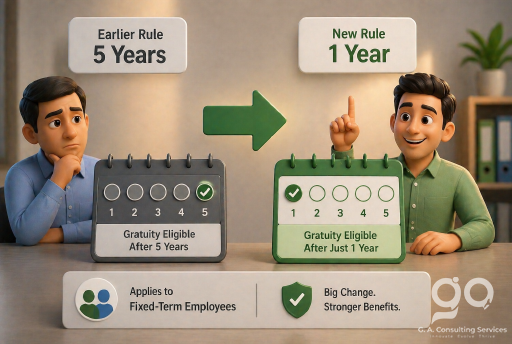
Under the new Labour Codes, gratuity eligibility and calculation rules have been updated. The most significant change is expanded eligibility for fixed-term employees, who can now qualify after 1 year of continuous service instead of 5 years.
2. Are fixed-term employees now eligible for gratuity?
Yes. Fixed-term employees can now receive gratuity after completing 1 year of continuous service, compared to the previous 5-year requirement. This applies from 21 November 2025.
3. Does the new wage code affect gratuity calculation?
Yes. Since the wage code mandates that Basic Salary must be a minimum of 50% of CTC, a higher basic wage may increase future gratuity payouts. Employers should recalculate their total gratuity liability accordingly.
4. Will the new rules affect my take-home salary?
Possibly. If your basic salary increases to comply with the 50% rule, PF contributions will also increase, which may slightly reduce your monthly take-home pay. However, your long-term retirement savings will improve as a result.
5. Does the new Labour Code change the gratuity formula?
The formula itself remains the same. However, the definition of "wages" is now standardised. If allowances exceed 50% of CTC, the excess is added to wages, which increases the base amount used to calculate gratuity.
6. Are employers required to update payroll structures?
Yes. Employers must revise salary structures, employment contracts, and payroll systems to comply with the updated wage and gratuity rules effective November 2025.
7. When do these new gratuity rules become effective?
The new Labour Codes, including updated gratuity and wage provisions, came into effect on 21 November 2025. Employers are expected to be compliant from this date.
8. Will my CTC change because of the new rules?
No. Your CTC remains the same. Only the internal breakup of your salary may change to comply with the government's wage-structure regulations.
9. Why were these changes introduced?
The new Labour Codes were designed to provide stronger social security coverage for workers, standardise wages across industries, reduce the misuse of allowances as a way to suppress statutory contributions, and improve PF and gratuity benefits for all categories of employees.
10. Where can employees ask questions about the updated rules?
Employees should contact their HR or payroll team in the first instance. For external guidance, a statutory compliance consultant or payroll partner can provide specific advice on how the rules apply to your organisation and role.

The new Labour Code gratuity rules represent one of the most significant changes to India's statutory benefits framework in recent years. Fixed-term employees gaining gratuity rights after 1 year, combined with the broader definition of wages, means most organisations will need to recalculate liabilities, update contracts, and restructure payroll — all before the compliance deadline has passed.
The four steps outlined above are your starting point. For organisations managing large or diverse workforces, getting external expert support now will be faster and lower-risk than attempting to do this in-house.
Need help with gratuity recalculation and Labour Code compliance?
GA Consulting provides end-to-end statutory compliance support — including payroll restructuring, gratuity liability assessment, contract updates, and employee communications — so your organisation stays fully compliant without the administrative burden.
→ Reach out to GA Consulting today for a free consultation.